Public beta
See how heat moves through a building
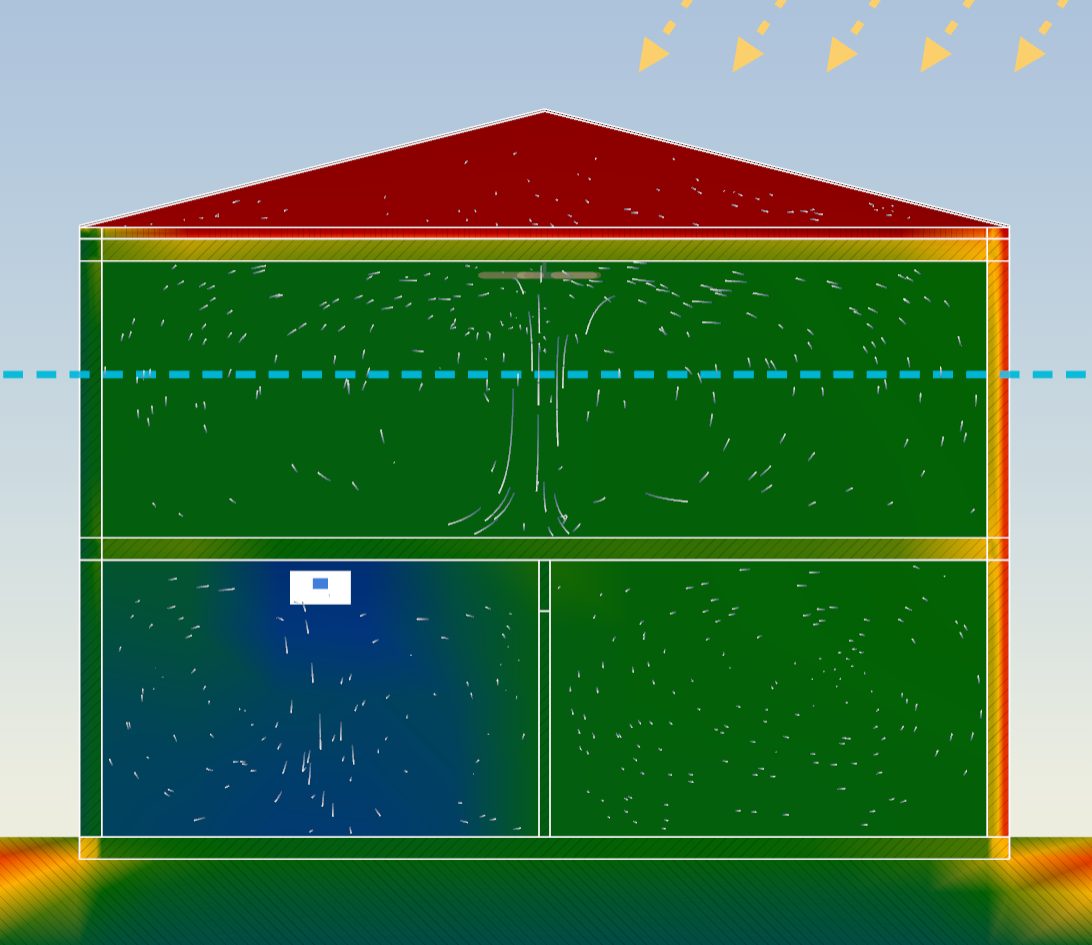
CaloView simulates heat and air movement inside a building, and draws the result as two linked cross-sections you can drag while it runs. A real CFD solver, in your browser. Nothing to install.
What you can do with it
-
Move the cut planes
Two linked sections slice the same running simulation. Drag one and the other follows.
-
Change the conditions
Outdoor temperature range, deep-soil temperature, ceiling fan on or off — while it runs.
-
Probe a point
Click a section to read its temperature and material.
-
Run it fast
100× to 2000× real time. A full day in minutes.
What the model does and does not include
A real solver, but a narrow one. Worth knowing before you read anything into the numbers.
It solves
- 3D heat transfer through air, walls, slabs, roof, and soil
- Buoyancy-driven airflow — warm air genuinely rises
- HVAC control, airflow, and heat delivery
- Solar gain on exterior surfaces and through windows
- Sky long-wave radiation on the exterior
- Long-wave radiation between interior surfaces
It is fixed, for now
- One 8 × 8 m two-storey house with a gable attic
- Latitude 45° N, 21 July
- Sealed glazing — windows admit solar gain but don't open; no doors
- Ceiling fan's position and size — on/off is all you control
- HVAC unit's position, size, and power — you set mode and setpoint
It does not model
- Ventilation or infiltration
- Humidity
- Calibrated turbulence
- The ceiling fan, beyond a qualitative push of air
How accurate is it? Comparative and qualitative. Good for “what happens if this changes” — not for sizing equipment or demonstrating compliance.
What you need to run it
It runs a CFD solver and a 3D renderer at once, on your machine.
- A recent browser — WebGPU where available, WebGL 2 otherwise.
- Best viewed on desktop, where the larger screen gives the 3D view room to breathe — but it should work fine on a phone or tablet too.
This is a beta — feedback is welcome
The solver is further along than the product around it. Whether it works for anyone else is what this beta is meant to find out.
Especially useful
- Do the linked sections make sense on their own?
- Does what you see match what you would expect?
- Did it run, and how fast?
Already known
- You cannot load your own building
- Location, date, and weather are fixed
- No energy figures, no export
All on the roadmap — feedback helps prioritize which comes next.
Write to contact@caloview.com — good, bad, or merely puzzling. If something went wrong, noting the browser and operating system helps track it down.